New interview up over at Filmmaker Magazine with Weapons cinematographer Larkin Seiple. Unfolding in overlapping chapters, writer-director Zach Cregger’s follow-up to Barbarian follows a small town’s unraveling after 17 students from a single third-grade classroom disappear overnight. The film was shot in Atlanta on the Arri Alexa 35 with Master Anamorphics, Canon K35s and Laowa probe lenses.
Check out the full interview. Here’s a few snippets:

On choosing the film’s lenses…
Seiple: We did a really fun lens test. I took Zach to Keslow in Atlanta, and we brought out a ton of lenses just because I was like, “Let’s talk about everything.” We had originally discussed shooting it spherical, so I showed him Master Primes, Super Speeds and some more vintage glass. Then I showed him some dramatic anamorphics and he was like, “Definitely not that.” As we got to, like, the eighth set of lenses, he was like, “These are great, but I can’t really notice the difference. You can maybe try to point it out to me, but when you show me these three lenses back-to-back it just feels the same.” So, I said, “Let’s try these lenses out” and threw on a Master Anamorphic and he was like, “That! That just feels like a movie. I can’t express what it is about that lens, but when I look at this shot in a boring house it now looks cinematic.” So, I was like, “Well, I guess we’re shooting anamorphic.” “Those are anamorphic? They’re not bending and distorting.” “Yeah, these are the fancy Arri-style ones that kind of look like Master Primes.” So, we brought them to stage and tested them. We then took them and did all the hair and makeup tests with the actors to make sure it was still the right choice and we loved it. I also showed him the Canon K35s, which wide open feel a little unhinged. They’re sharp, but they get a little glowiness to their highlights. We used those for Austin Abrams’ chapter as James. They just felt like his character. At one point we talked about doing different lenses for each chapter, but it started feeling tedious and unnecessary. It felt better to unify almost every chapter under the same aesthetic because they’re all kind of in the same trouble. But James’s chapter is so different from everything else that it felt right for his. We used wider lenses for him. We were closer. We just wanted to feel his character more because the shot structure is very different in his chapter compared to the others.

Filmmaker: I don’t know how many of the 17 kids we actually see sprinting into the night in that opening sequence, but it’s a lot of them. Was it difficult to come up with that many different yet interesting wide shots?
Seiple: It was a lot of us doing our normal 12-hour prep day, then me and Zach getting in the car and being like, “Well, our [hero] house is here and there’s six neighborhoods around it. Let’s go find some shots.” We found probably 30 different houses to shoot. We’d drive around and say, “Oh, if you look through the backyard of this house, you can see this other house and there’s a porch light there.” There’s this amazing drain in the movie, this sewer underneath the grassy hill that you see in the opening. That was something we found while scouting. We used the top of that sewer for one of our night shots where the kids were running across in silhouette against a house. So, a lot of it was just doing that extra work to find each location, then we had to cull them down. We actually made an animatic of all of our stills from those scouts and put it to the George Harrison song [“Beware of Darkness”] so we could figure out how many shots we needed for the sequence. It was an arduous process. We would shoot a normal day, then I would go and join a second unit after we wrapped and shoot for a few more hours to get the [montage of the] kids. We had about a week to shoot those, and we were shooting in summer, so we could only shoot from 9 pm, when it got dark, until midnight [when the kids had to be wrapped]. So, we had three hours and then the kids became pumpkins, as we say.

Filmmaker: When you’re shooting a scene that’s going to be experienced twice from different characters’ perspectives, like Austin’s confrontation with Alden Ehrenreich’s cop, obviously you’re shooting both sides of that on the same day. Zach talked in an interview about how the approach would be different depending on whose POV you were in. So, for Austin’s side, you’re shooting Alden from lower angles and making him more menacing because that’s how he feels to Austin’s character.
Seiple: We did play with that. The first time we shot Alden talking to Austin, it’s a neutral two-shot. They’re on the same level in a way and Alden literally says, “I did you wrong. You did me wrong.” Then when you get to Austin’s [chapter], to him he’s been assaulted by this cruel, evil cop. We talked about every character’s chapter having a theme when we first sat down. For Alden’s chapter, the world passes him by. He’s like a buoy. All these things happen and he’s just adrift and decides to make the wrong choices. There’s a lot of profile shots of him because he’s never necessarily the hero. All these things are moving around him. Whereas Justine [Julia Garner, as the missing kids’ teacher] is very much being preyed upon, so the camera’s more paranoid. It’s wrapping around her. It’s over her shoulder. We’re constantly moving with her. Archer [Josh Brolin, playing a missing kid’s father] is very much a hunter. He’s on a mission. So, there’s a lot more shots from behind him or in front of him pulling and pushing and he is dead center. It’s fun to have these ideas at the beginning. We had a big talk about them, and we got excited and then when you start shotlisting, you completely forget you ever had that conversation. [laughs] It’s great to have big, pretentious ideas, but it’s also nice to just shotlist based on what the scene needs and what makes sense. Then you find those ideas [organically] working their way in again.
****Spoilers****
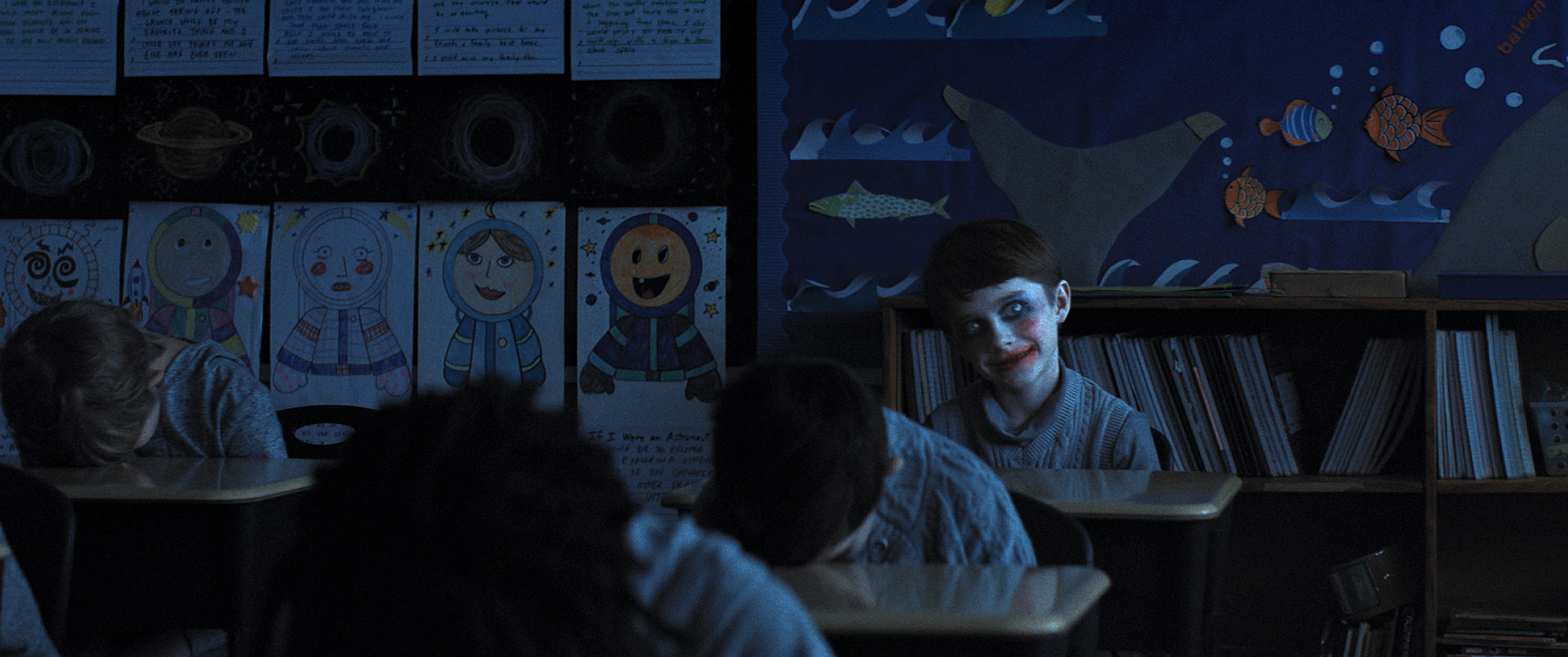
Filmmaker: We talked earlier about jump scares, so let’s get into the ones during Julia Garner’s dream sequence. I don’t remember exactly how far into the film this comes, but it was long enough that I started to think, “Maybe this isn’t going to be a jump scare kind of horror movie.” Then you hit me with two of them back-to-back in that dream.
Seiple: One of them is the classic jump scare thing where she wakes up from a nightmare and your brain is like, “Is she still in the nightmare?” She looks around her house and peers out around her door and nothing is there, and I think everyone should know at that point when the main character takes a deep breath that a jump scare is coming. So, she leans back [and there’s a blur cut as the camera tilts up to see Amy Madigan’s Aunt Gladys on the ceiling]. We shot half of it on our real set and tilted the camera up to an empty ceiling, then rebuilt the ceiling upside-down on stage and cut a hole out of it so Amy could lean a certain way. When you have someone on the ceiling, you’re like, “How do we make this look scary?” If she’s standing straight up, you can’t really see her. So, she had to lean backwards, and we had to bring in a support for her back. It became this cumbersome thing to try to make this image that will hopefully haunt you.
There is another jump scare in Josh’s dream when he’s talking to his son in his bed and there’s a splash of Amy. We shot that a couple of times using the same lighting. It was really creepy, but it wasn’t scary. So, I was like, “I need to change the lighting.” As I’m thinking about that, makeup goes in to touch up Amy and a grip had this gross flashlight that he pointed at her face for the makeup team [to be able to see]. I’m looking at the monitor and I’m like, “Oh my God, Amy looks like a ghoul.” So, I asked Zack to give me one more take and when he yelled action I took the grip’s flashlight and swung the light on Amy’s face, and it brought out all of these textures. You can see Amy’s lipstick on the weird little baby teeth that we gave her.


 deep fried movies