
Interviews
Dìdi cinematographer Sam Davis
“We had this mantra that stillness is a 13-year-old boy’s worst nightmare.” In the opening scene of Dìdi, the titular 13-year-old and his friends film themselves blowing up a mailbox […]
“We had this mantra that stillness is a 13-year-old boy’s worst nightmare.” In the opening scene of Dìdi, the titular 13-year-old and his friends film themselves blowing up a mailbox […]
“We had this mantra that stillness is a 13-year-old boy’s worst nightmare.”
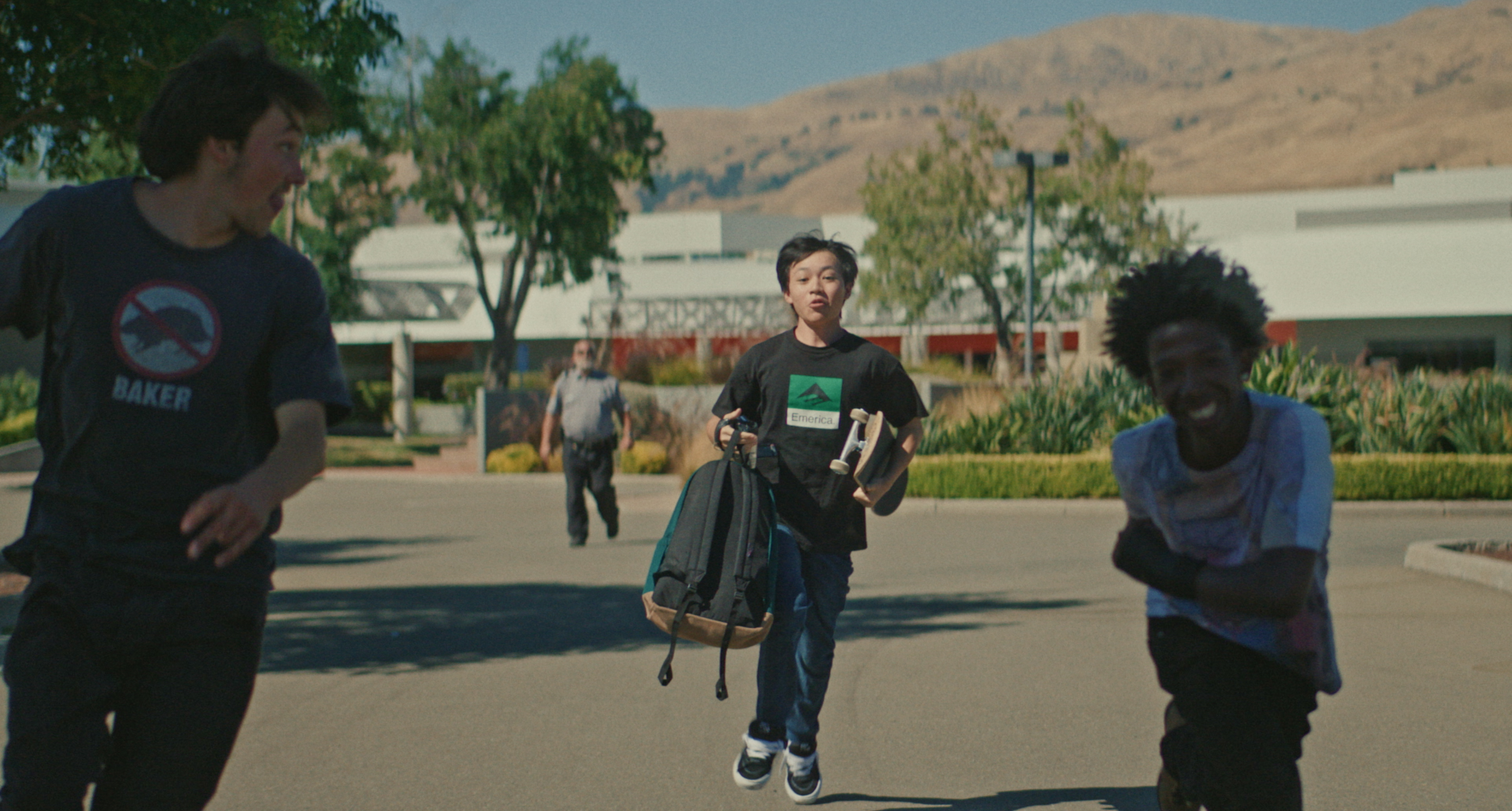
In the opening scene of Dìdi, the titular 13-year-old and his friends film themselves blowing up a mailbox and making a run for it while laughing hysterically. It perfectly encapsulates director Sean Wang’s view of adolescence as “the worst version of yourself, having the best time of your life.”
Set in 2008 in Wang’s hometown of Fremont, California, the coming-of-age story follows a Taiwanese American teen during his final summer before high school. Though not strictly autobiographical, the film was inspired by Wang’s own adolescence and the making of it was awash in familiarity. The main character’s bedroom scenes were shot in the director’s own childhood room. His grandmother plays a prominent role, one of many first time Bay Area actors in the cast. Behind the camera was Sam Davis, a longtime collaborator who Wang met on his first day of film school orientation at USC.
With Dìdi now out on VOD, I spoke to DP Sam Davis for Filmmaker Magazine. Check out the story here. Below you’ll find a few excerpts from the piece.
The movie was shot in 25 days entirely on location in Fremont with an Alexa 35 and Arri Zeiss Master Anamorphics cropped to 1.85.
Davis on getting behind the camera as a kid in Michigan…
Davis: I grew up in a tiny town called Potterville. I started making films at a really young age. When it came time to start thinking about a career it was pretty obvious to me that’s what I wanted to explore. I ended up moving to L.A. when I was 18.
Filmmaker: When you started shooting as a kid, what era of cameras where we in? Are we talking the little DV tapes?
Davis: There were DV tapes at first, then I moved into the DSLR era. My dad was a high school football coach and the first camera I got my hands on was the football team’s camera that I would always steal. One day I was making one of my first films, this little war movie. I rounded up all the kids from my town and we made these makeshift military uniforms. We were shooting in a creek, and I fell in. The high school football program’s camera fell in with me. I spent an entire summer mowing lawns to buy the program a new camcorder.

On visually differentiating the protagonist’s home life from his social life…
Davis: We definitely wanted to distinguish between the feeling of the photography within Wang Wang’s home and outside the home. We had this mantra that stillness is a 13-year-old boy’s worst nightmare. So, in and around his home, which is kind of half the movie, it’s like the camera weighs a thousand pounds. If there’s any movement, it’s very slow. It hopefully creates this feeling of a kid who’s stifled and feels the weight of his family. The idea then was for everything [outside the home] to be a bit more untethered. There’s not a lot of handheld, but there’s some Steadicam and dolly shots. The movie definitely opens up in terms of both lighting and camera movement. Part of the film’s look is also just about keeping it really simple and, in general, designing a look that didn’t call too much attention to itself, both for story purposes and also just the practicality of shooting a little indie movie like this with a cast full of kids who have really strictly regimented work hours.
On maximizing the shoot days despite the work restrictions of Didi’s young cast…
Davis: We still generally did 12-hour days. We were clever in all the ways we could think of, [like] Sean body doubling for Izaac anytime we didn’t see his face. Our directing mentee, Anna [O’Donnell], would also body double for him. There’s a sequence where Wang Wang runs away from home, and you see him walking through the streets at night. That was Anna, our directing mentee. We had a little wig for her, and she was approximately the same size as Izaac. There were some shots where you could tell, and of course those didn’t make the movie. Anytime we’re over Wang Wang’s shoulder, it’s not him. We could also spread out the hours we had with Izaac. We could send him to school for a certain amount of time in between setups and do other things with other coverage, but it was always critical that as soon as he walked on set, we had to be ready because that clock started ticking. Then as soon as we had an opportunity to do something with other actors or that didn’t involve him, we would send him away to school to start clocking his school hours.
On his lighting package…
Davis: I come primarily from a documentary background and so, generally speaking, for a day interior I always like to start with the blank canvas of a nice window light, then we could supplement and shape as needed. We had one M90, which was our biggest unit, and would sometimes push that through windows. Then we had a lot of small LEDs for the interiors, things like Lite Mats and LED tubes. I had never used pool noodles before. I don’t know if you’ve heard of this, but it’s just as crude as it sounds. It’s a literal pool noodle that you cut and then stick around an LED tube. I love the quality of light that we got from those. We would carry those around like little wands and that was a really helpful and fast way to work.


 deep fried movies