
Interviews
Longlegs cinematographer Andrés Arochi
“I always wanted to leave blank space in the frame because, for me, fear lives behind your back.” – Andrés Arochi New interview up over at Filmmaker Magazine with Longlegs […]
“I always wanted to leave blank space in the frame because, for me, fear lives behind your back.” – Andrés Arochi New interview up over at Filmmaker Magazine with Longlegs […]
“I always wanted to leave blank space in the frame because, for me, fear lives behind your back.” – Andrés Arochi
New interview up over at Filmmaker Magazine with Longlegs cinematographer Andrés Arochi. It’s the feature debut for the Mexican DP. Shot on 35mm (with Cooke S4s, in an homage to Harris Savides), Arri Alexa LF (with Arri Signature Primes) and a vintage VHS camara.
Check out the full story here or a few excerpts below.
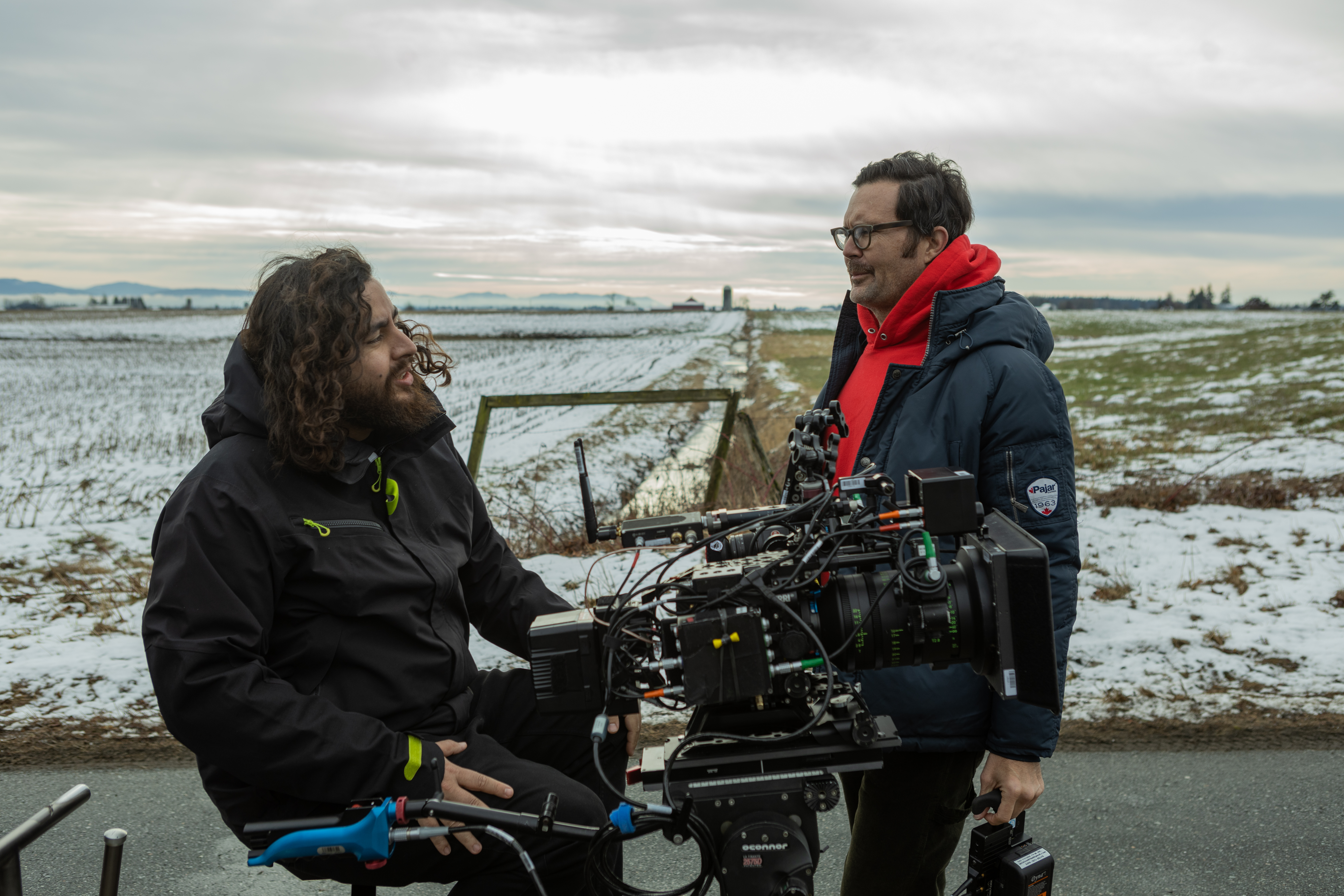
On shooting the film’s flashbacks in 35mm…
Arochi: Originally, we wanted to shoot all the movie on film, but then we decided that we didn’t want to really focus on all those technical aspects during the shoot. We really wanted to work with the actors and focus more on the narrative side of filmmaking. But we did want to separate the 1970s [sections of the movie] from the 1990s. So, I decided to shoot 35mm for everything in the 1970s and go with a 4:3 aspect ratio, then we did 2.39 and shot on digital with the Alexa Mini LF for the 1990s.
Filmmaker: Did you use the same lenses for the 35mm and the digital?
Arochi: No, our film package was an homage to Harris Savides, who’s one of my favorite DPs—Oz’s too. We used Cooke S4s with an Arri 35mm camera for the flashbacks. Our main package for the 1990s was a Mini LF with Arri Signature Primes. My biggest fear was someone waiting on me, like having to tell Nicolas Cage, “Wait a second. There’s something wrong with the lens.” I just wanted to be perfect. I wanted to be a samurai, where the actors didn’t even notice us working. So, we went for things that we knew were going to work the first time. Sometimes when you work with vintage lenses, they won’t work how you want them to, especially when you’re going from a very cold exterior and then coming into a warm interior and everything starts falling apart. I couldn’t afford that. I didn’t want anyone to wait for us during the shoot.

On the film’s inspirations…
Arochi: There are definitely some references in this movie, but I think those references are more built into the script. While we were working, we never talked about Silence of the Lambs. We never looked at frames [from other movies]. When we did talk about movies, it was more movies that had nothing to do with the genre. We talked a lot about My Own Private Idaho, Drugstore Cowboy—a lot of Gus Van Sant 1990s indie America filmmaking. Elephant was an influence on the way we used Steadicam.
Filmmaker: Didn’t Harris Savides shoot Elephant?
Arochi: Yeah, it’s one of his best movies. For me, Longlegs was more about seeing what Maika was going to do and seeing what the art team gave us, then start creating from there. Again, it was more coming from an emotional place than a conceptual one. I began to notice that Maika as Agent Lee Harker barely moves. She’s always practically frozen and she stays a little further away from people than normal. So, I started playing around with that and giving her a wider lens. Even if she’s in a room surrounded by people, let’s abstract her. Let’s make her become different from everyone else.

Filmmaker: One of the things that struck me about the film is the really wide field of view. What were the wider focal lengths that you were pairing with that Alexa LF?
Arochi: I really wanted to have a full kit of lenses to play with and that’s something the Signature Primes gave me. I think the widest was a 12, which we only used for inside the cars.
Filmmaker: What about the shot looking down the stairs in that opening raid with Maika? There’s an expressionistic quality to that image. That’s not a 12?
Arochi: I think that was more like a 16. Things on the LF look very, very wide and that started to create a language. It was weird for the actors as well. Nic Cage would always ask me, “What lens are you on?” And I’m like, “A 16.” He would look at me like, “You’re very wide. I thought this was my close-up.” And it’s like, “Yeah, this is your close up.” [laughs] I always wanted to leave blank space in the frame because, for me, fear lives behind your back. It’s not in front of you. If you’re working on your computer at 1 a.m. and you feel something, it’s always behind you. So, it was this idea of always having space for fear to live.


 deep fried movies