
Interviews
In a Violent Nature cinematographer Pierce Derks
“It’s never bothered me to have gear that doesn’t look slick or that looks a bit like a monster itself, as long as it gets the job done.” Abel Ferrara […]
“It’s never bothered me to have gear that doesn’t look slick or that looks a bit like a monster itself, as long as it gets the job done.” Abel Ferrara […]
“It’s never bothered me to have gear that doesn’t look slick or that looks a bit like a monster itself, as long as it gets the job done.”
Abel Ferrara has said, “In movie making, money is no excuse. It doesn’t cost anything to set up a cool looking shot.” In a Violent Nature is the embodiment of that credo. A deconstruction of the slasher genre, the movie tells a familiar story from an unfamiliar point of view as the camera stays with its undead killer Johnny (adorned in a vintage fireman’s mask and armed with a pair of logging hooks) as he traipses through the forest from victim to victim. The film poses the question, as director Chris Nash puts it, “What if Gus Van Sant directed a Friday the 13th sequel?” Or, if you prefer editor Alex Jacobs’ hypothetical, “It’s like if Pablo Larraín’s Jackie was about Jason Voorhees.”
That stylistic cross-pollination was not easily obtained. Principal photography began in September of 2021, but four weeks into the shoot—with roughly 80 percent of the movie completed—the original actor playing Johnny fell ill and production shut down. Initially the plan was to simply pick up the rest of the missing footage, but once Nash began editing he found himself underwhelmed. It was decided to reshoot the movie in its entirety using what remained of the budget. Pierce Derks, a veteran of second unit practical effects work who served as on-set documentarian on the initial shoot, stepped into the cinematographer role for the redo.
With In a Violent Nature now out in theaters, check out my interview with Derks over at Filmmaker Magazine. Here are a few excerpts from the story.
On shooting with the $5,000 Canon C70…
Derks: I was really happy with it. Sometimes the rolling shutter can be a little janky, but that’s an issue with so many cameras. In terms of highlight retention, it performed fantastically. It essentially uses the same sensor as a C300 Mark III, just in a smaller, more condensed body, which was perfect for us not only for budgetary reasons but also for lugging the camera around. It was important to have a camera package that I could literally throw in a backpack and take to where we needed, as opposed to trying to have multiple assistants hauling camera carts to bring all the stuff out. That was just not feasible with where we were shooting.
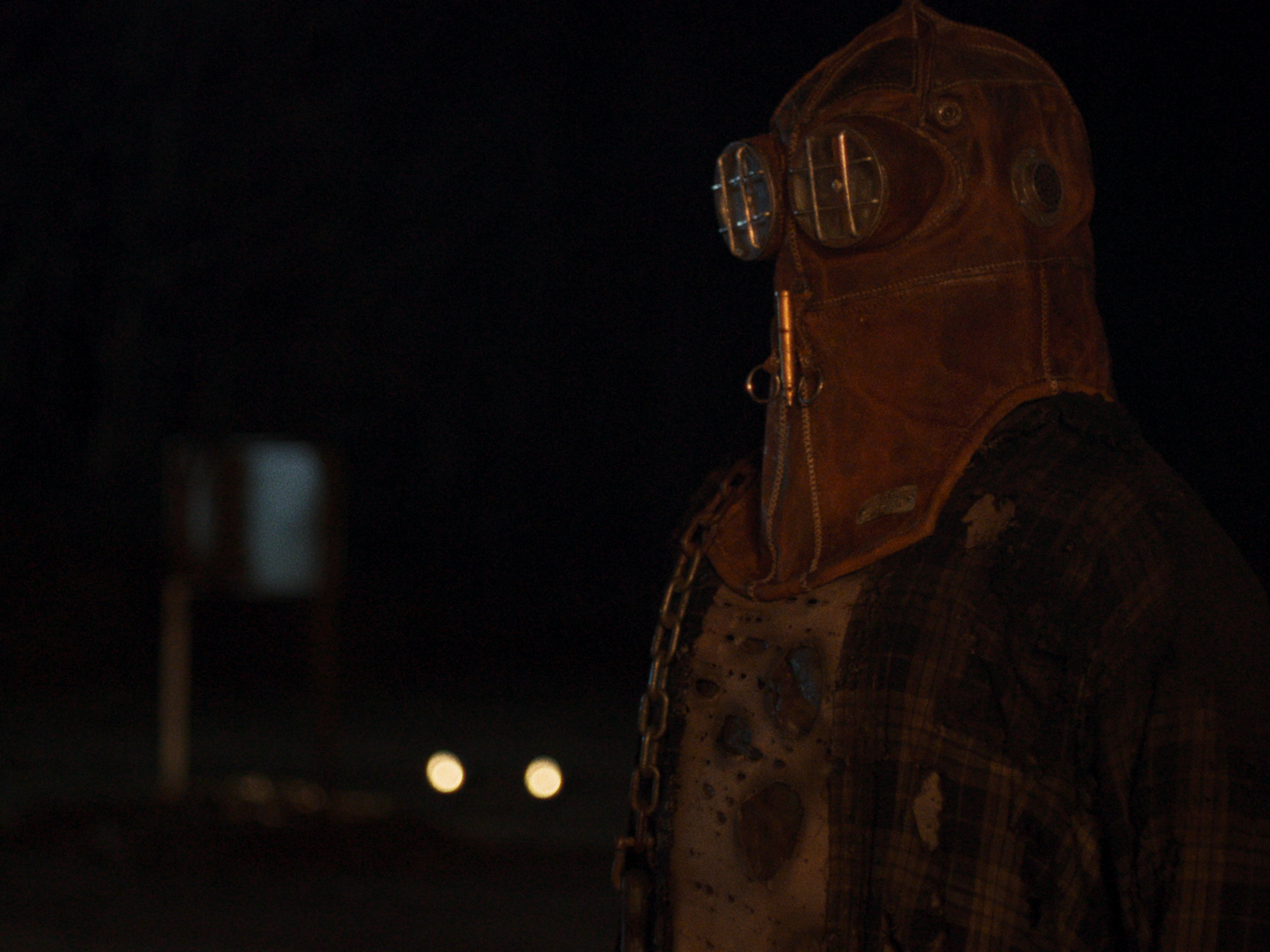
We shot most of the film in Canon RAW at 800 ISO, which is the base, then for nighttime scenes we switched to, I think, MXF, because Raw turns off a little bit of noise reduction and we wanted that. I did boost the ISO for a few particular night scenes to get a little bit more grit and grain out of it. When Johnny walks out [of the ranger station] wearing his mask for the first time, we shot that at a really high ISO. I love the texture that it had. It felt almost like Super 16.
On the campfire exposition scene…
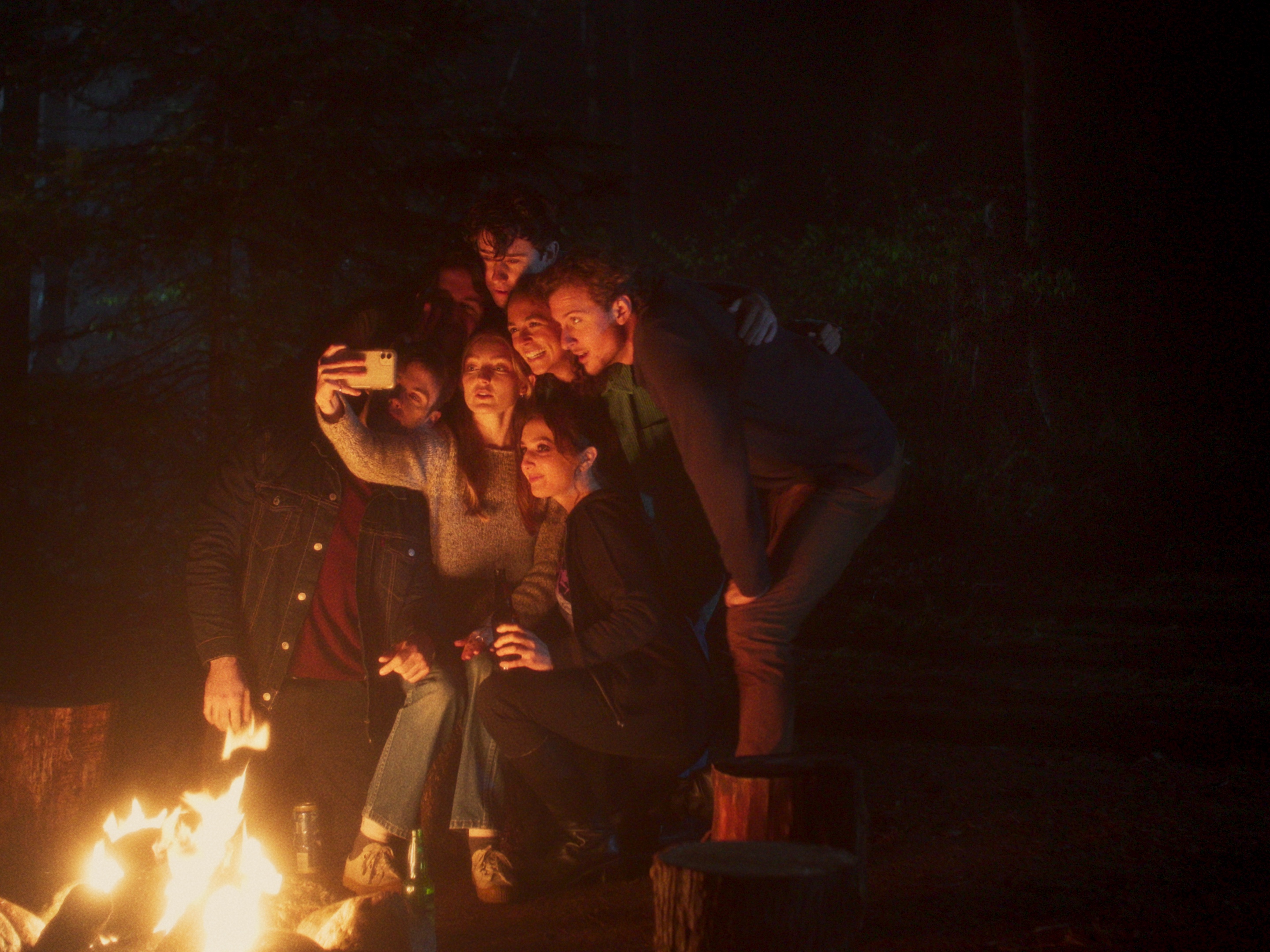
Filmmaker: One of the only scenes that strays from (the killer’s) perspective is the campfire exposition, where one of the potential victims relays Johnny’s backstory. It’s a circular dolly shot at night, which sounds like a challenge with a small crew and a limited number of lights.
Derks: Yeah, the campfire scene was a tricky one. It was one of the few times we were on a more controlled [camera movement system] like a slider or dolly. We built a small platform surrounding the area where the campfire would be, because we knew that we would not have enough time to actually properly balance out the circular dolly track [on the ground] on the day. So, we just built a platform and leveled it out. To make things even more difficult, it was also raining that evening and after a couple of takes the actors were soaked and we had to call it. In terms of our G&E package, almost all the exteriors were run exclusively off one 2K generator. The strongest light that I ever had going was an Aputure 600D, and we never had any lifts. Our biggest stand was a Mombo Combo. We were always trying to find ways to hide stands behind trees. We wanted to get just enough light to get some detail and texture on the trees, so it didn’t feel like we were just in some black, empty void that felt like a studio space.
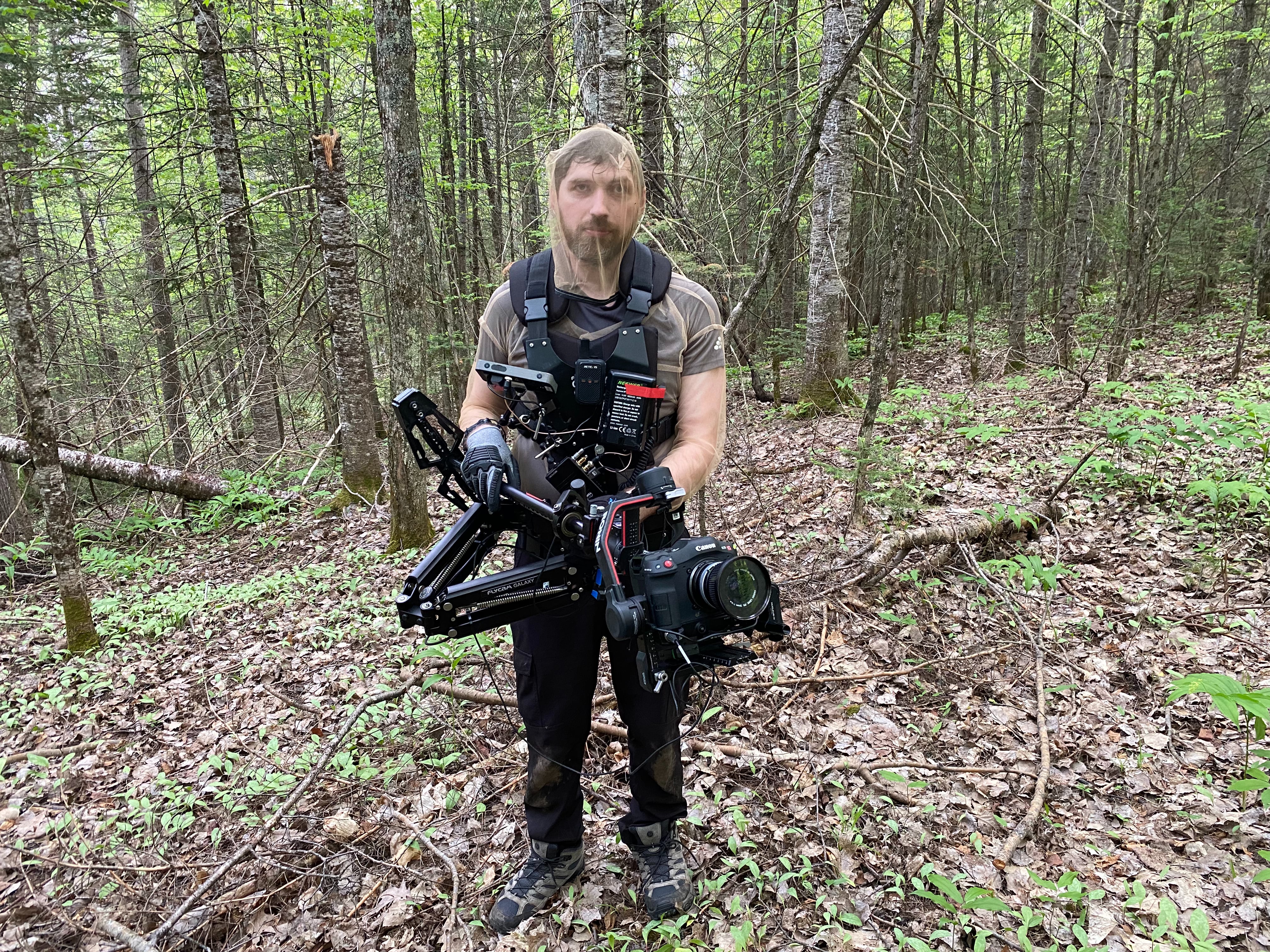
(Above) Derks in protective netting to fend off the location’s persistent flies. The photo also shows his Frankenstein gimbal rig, which combined a Steadicam-like vest and spring arm, a Glidecam sled and a Ronin RS 2 rigged on top.
On dealing with Northern Ontario black fly season…
Filmmaker: In a lot of the behind-the-scenes photos, everyone is wearing these yellow nets. Are those for bugs?
Derks: Yes. Northern Ontario is notorious for its black fly season.
Filmmaker: Are those like horseflies?
Derks: Kind of, but smaller. The black flies would latch on to you and it doesn’t matter how many layers you’re wearing—they will just continuously chew through the layers. One day I counted after we were done filming and I had almost 200 bites on me, and that was with the bug spray and those nets and I was wearing like wool and all these layers. They were absolutely relentless.
Filmmaker: You had to operate wearing those nets over your face?
Derks: Yeah, some of the time I had to operate with the net on and the bugs would still be crawling through. It didn’t really bother me most of the time if the bugs were on me, but what was pissing me off was when the bugs would land on the lens and swarm around the camera. They’re attracted to heat. It’s so embedded in me as part of the camera department to wear black, so you don’t cause any reflections and don’t interfere with the lighting. But because of that, the bugs were extra attracted to the heat [from that black clothing] and also the heat from the camera. There was this little cartoon cloud of bugs circling me everywhere that I went. For some shots our producer was off to the side waving a flag to try to keep the bugs from completely obscuring the frame. Our sound team, Tim Atkins and Michelle Hwu, latched onto that and created this motif of this ominous sound of flies buzzing that ended up being almost like an indication that death was on its way. It added an extra layer of texture to the film, but it was miserable trying to work that way.


 deep fried movies