
Interviews
The Killer cinematographer Erik Messerschmidt
“The camera has a part to play in the image making process, but it’s akin to a hammer, a tennis racket or a guitar.” The Killer begins with an assassin (Michael […]
“The camera has a part to play in the image making process, but it’s akin to a hammer, a tennis racket or a guitar.” The Killer begins with an assassin (Michael […]
The Killer begins with an assassin (Michael Fassbender) in a half-completed WeWork office awaiting the arrival of his latest target. As he waits, he details his vocational mantras for the audience in voiceover: stick to the plan. Don’t improvise. Never yield an advantage. Forbid empathy. Fassbender proceeds to miss his shot and spends the rest of the film breaking each and every one of those tenets in the chaotic aftermath.
Many of the pieces written about the film have pointed out perceived similarities between the film’s methodical, detail-oriented titular character and the perfectionist reputation of its director, David Fincher. However, what makes Fincher’s approach to filmmaking so fascinating is the way it combines the fluid with the obsessively regimented. For The Killer, the illusion of handheld camerawork, anamorphic lens characteristics and glass filters were all created in post, where they could be minutely modulated. Conversely, Fincher often prefers to design coverage on the day after blocking rehearsals and is open to the spontaneous comedic possibilities of the cheese grater.
On Fincher’s Mindhunter, Mank and now The Killer, cinematographer Erik Messerschmidt has been the director’s partner in that duality. Check out my full interview with Messerschmidt over at Filmmaker Magazine – the Oscar-winning DP’s fifth appearance in the column.
Here are a few excerpts from the piece…

On the film’s opening “hit gone awry” sequence…
Filmmaker: Tell me about how the look of that WeWork space progresses through the day.
Messerschmidt: A lot of it was driven by the plates. Outside of those windows are LED walls. We shot the plates in Paris at specific times of day and discussed the color palette of the city. So, all of the ambient light that’s coming through those windows, for the most part, is driven by the color temperature of the plate. For some of the shots, in order to get the shape I wanted, I had to use artificial light as well. I couldn’t just use the LED walls because they were too soft. So, I’d use harder sources as well to push light through the windows.Filmmaker: What did you use for that on-camera work light for the night scenes? Was that something off the shelf from a hardware store or something custom made?
Messerschmidt: It’s a work light that the electricians modified. We put an LED in there so we could control color temperature and brightness. I love that kind of burnt yellow look, obviously. [laughs] I could get that color quite easily by putting the camera at like 3800 Kelvin, then bringing in that light at 3000 Kelvin and pulling the red out of the image.
On creating the film’s handheld shots by destabalizing in post…
Filmmaker: Let’s circle back to how you created a handheld look through destabilizing the footage in post.
Messerschmidt: David initially said, “What if we do the whole movie handheld?” But there’s a practical consideration to that, which is that the camera is going to be on the operator’s shoulder for 10 hours a day The way David shoots, we have maybe 30 or 40 seconds between takes and we’re rolling again. It’s not the sort of thing where we shoot one or two takes, then go to the next shot. The way that we work, I just didn’t think it was practical, honestly, and ultimately, he agreed. So, then David said, “Well, maybe the whole movie isn’t handheld. Maybe there are scenes that are handheld, and we do this thing where we tie the camera movement and the scene structure to the character’s point of view, his mental state.” I thought that was an interesting idea. So, David said, “Go through the script and mark off the scenes you think should be handheld and the ones that you think should be static and I’ll do the same.” The two lists were almost identical. So, that’s what we ended up doing.
I shot some handheld tests against, like, a lens grid or a chart—I can’t remember exactly what it was. I did some steady ones, then I’d have a couple shots of espresso and do some [less steady] ones. Then I shot some static shots, and we sent them to post, and they basically mapped my camera shake onto the (static) shots. It actually became really exciting because it was like, “Oh, now we can art direct the handheld. We can make this really shaky, then we can stop it, then it can be really shaky again. We can put a bump with a sound effect, or we can take a bump out.” That became really seductive. I would say probably 90 percent of the handheld in the movie was done on a fluid head. We did have a Ronin there, but we didn’t use it like a gimbal [with an operator holding it by the handles and moving]. I used it more like a remote head, particularly in places where it’s just not practical to put an operator. There are some shots—like when Michael is running along the side of the house in the Dominican Republic—that are actually handheld shots. There’s some in the fight [in Florida] as well, but not many.Filmmaker: It would’ve been less controllable than the approach you ultimately took of destabilizing in post, but did you look at using the handheld mode on the Oculus head?
Messerschmidt: For that you basically put the control of the Oculus on the operator’s shoulder. So, you can put the Oculus on a Technocrane and then the operator [has a handheld device that they move around to control the camera]. We looked at that and David ultimately said, “I can do this in post and decide exactly how much shake I want.” With [real handheld], controlling [the level of shake] can be a problem, especially in a complex scene like a fight scene that shoots for several days. The personality of the operator ends up coming into the shot and it’s difficult to attenuate the amount of shake from shot to shot. In that Florida fight scene, there might be 60 shots. Fatigue is a factor and body position is a factor. Those things end up translating to the shot and you can have a lot of almost schizophrenic operating in the process, because shot five of the day is going to be slightly different from shot 25 of the day just by nature of [the operator] being a human being. So, we wanted to be able to really control the arc of how much the camera moves in a scene—which may be a little bit obsessive, but I think it’s certainly interesting.
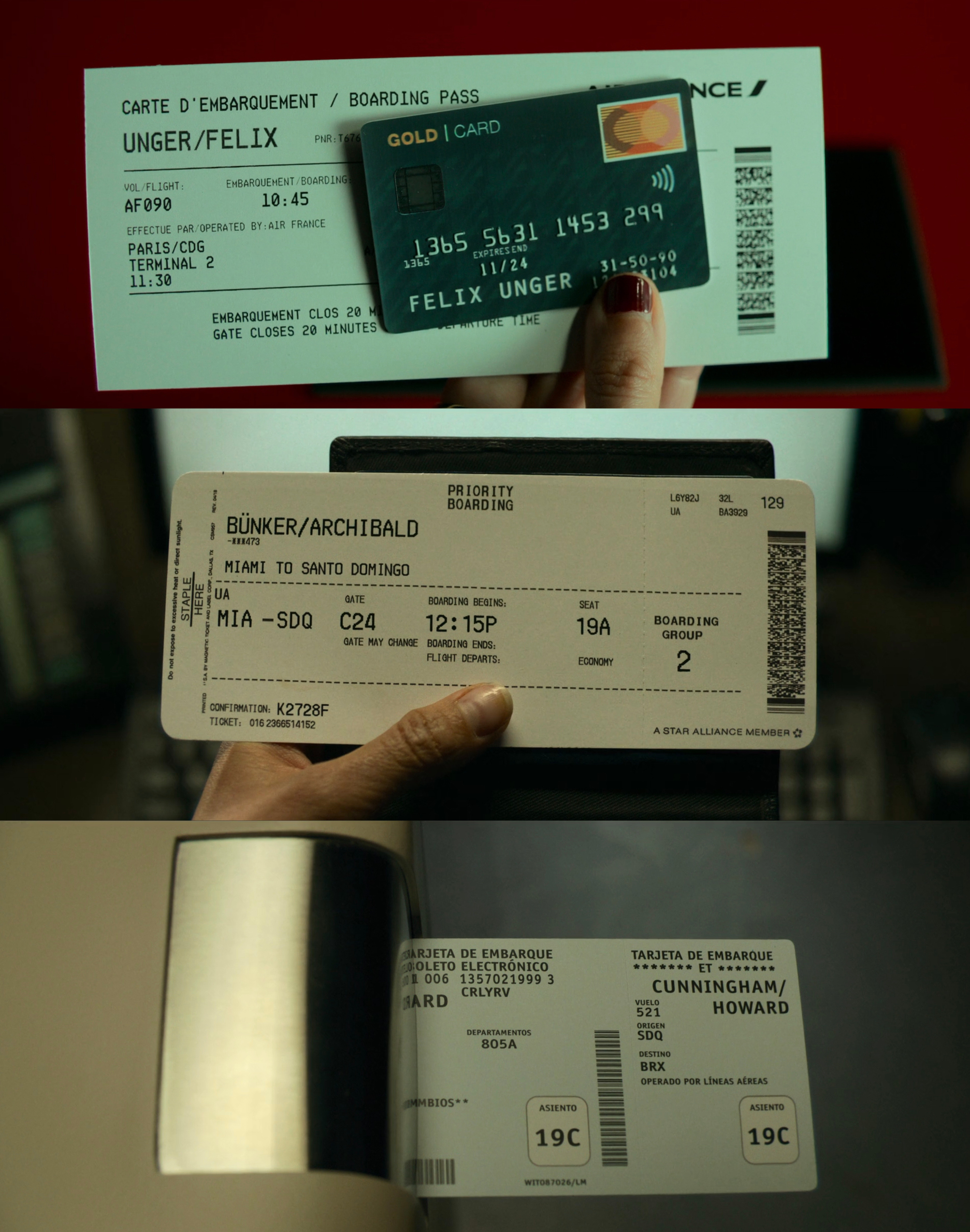
On the film’s running bit of Fassbender’s aliases…
Filmmaker: When did you realize how funny the movie was going to be?
Messerschmidt: I wouldn’t say that there was much levity in the shooting. So much of [the humor] is from the comic timing of the voiceover and the crew was not hearing any of the voiceover while we were shooting. If you watch the movie with the sound off, it’s a completely different experience. (laughs)Messerschmidt: Which was an afterthought, by the way.
Filmmaker: Really?
Messerschmidt: Yeah, we did those as reshoots. The aliases were in the script, but then David and [screenwriter] Andy Walker said, “That’s actually pretty funny.” So, we went back and shot all the inserts of the tickets and everything.Filmmaker: So, during the main shoot you had, for example, the rental car counter person says, “Thank you, Mr. Bunker,” but you didn’t have the insert shot of the rental car agreement with the name on it.
Messerschmidt: Yeah, exactly. It wasn’t a repetitive kind of idea until the editing process where David was like, “Okay, we’re going to shoot tickets.” And I was like, “Really, we’re going to shoot tickets? Only three people are going to get this joke, David.” And he’s like, “No, no, we think it’s funny.” And, of course, now it’s a huge thing. How wrong was I?
On embracing the banal…
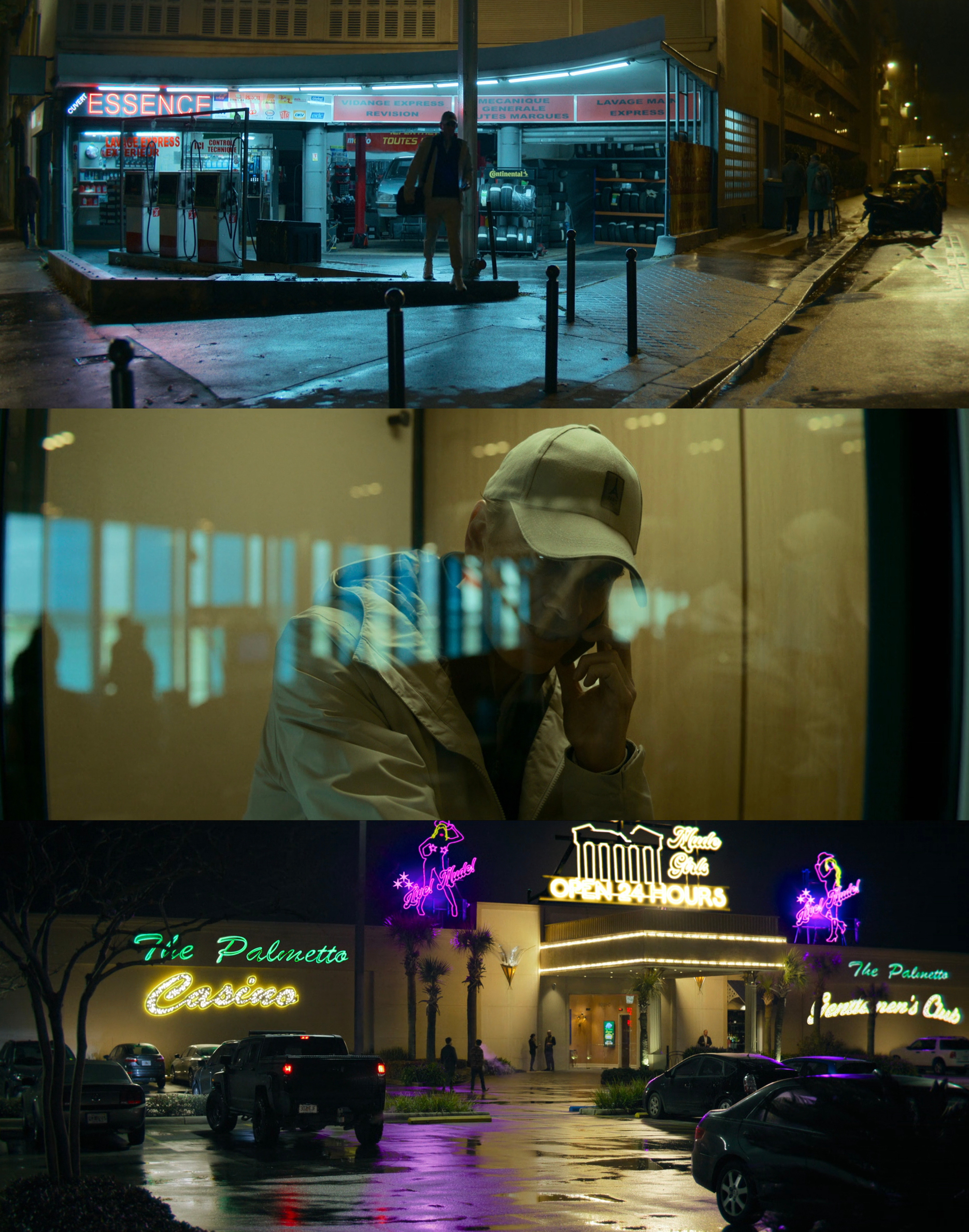
Filmmaker: I’m interested in this balance you’re striking in the film when expressing the drudgery of Fassbender’s job. Some scenes unfold in drab locations like a Marriott, a Starbucks or a Hertz, but there are also times when you make seemingly mundane locations look very striking. I’m thinking of things like the gas station, the car wash, the bank of airport phones and the casino parking lot.
Messerschmidt: David is always like, “Don’t be afraid of the banal. Lean into it.” We’re never really looking for beauty. It has to serve the story and serve the tone. I can never add something into the set that doesn’t already exist and be happy with it. If I’m in a top lit office and try to make it look like something other than a top lit office, I’m always dissatisfied. It doesn’t look real. It’s not interesting. It looks forced. I find it’s more about embracing what’s already going on. Like the shot at the airport where Michael is on the phone [the middle frame above]—that reflection was completely accidental. We added those phone booth pods to the real Air France lounge where we shot and we were like lining it up with a finder and I said, “David, look at this reflection! This is amazing.” And the color temperature [contrast] was obvious. We had this blue window, so I could put in all this warm top light and get a split tone thing. That ended up being kind of the look of the movie, this cool cyan and yellow/green split tone.
That shot you mentioned in the casino parking lot was the same thing [the bottom shot above]. David was like, “You’re going to love this location. You’re not going to have to light anything.” And then we lined up the shot and where he wanted to put the characters’ truck was totally black. (laughs) We tried moving the camera over, but then we couldn’t see the building. So, I said, “What if I put some lights on the roof and then you paint CG signs over them?” And David said, “What if they’re like a Hard Rock Café stripper girls things?” And I said, “Great, then we can animate them.” So, we got that effect [of the light from the sign moving] with a SkyPanel 360 doing this kind of magenta/purple color. Then they created the sign in post to match [the moving lights of the SkyPanel].


 deep fried movies